
Universe
The cosmos, simulated with real physics.
For desktop Chrome, Edge or Safari with WebGPU.
Universe runs on a desktop computer. Send yourself the link.
Nothing here is scripted.
Everything is simulated.
سَنُرِيهِمْ آيَاتِنَا فِي الْآفَاقِ وَفِي أَنفُسِهِمْ حَتَّىٰ يَتَبَيَّنَ لَهُمْ أَنَّهُ الْحَقُّ
We will show them Our signs in the universe and within themselves until it becomes clear to them that this ˹Quran˺ is the truth.
Real physics
Computed, not scripted.
- Yoshida-4Symplectic integrator
- 1PNGeneral relativity
- 2.5PNGravitational waves
- SI · float64Units and precision
- Birth to remnantStellar evolution
- WebAssemblyPhysics core
Checked against reality
We measured it.
-
42.98″per century
Mercury’s relativistic perihelion shift
Einstein: 42.98″
-
≤7km
Inner planets vs NASA JPL, after 10 years
Newton alone: 1,777 km
-
−2.399× 10⁻¹²
Hulse–Taylor pulsar orbital decay
Observed: −2.398 × 10⁻¹²
-
42.10°
The darkness below you at the horizon, as rendered
Published: about 42°
-
16.88°per year
Double Pulsar orbit turning (periastron advance)
Observed: 16.90° per year

Land anywhere real.
NASA elevation and imagery for Earth, the Moon and Mars, sharpening to about 10 m as you descend.

Fly out of the Milky Way.
One continuous universe with no loading screens, and the Sun in its true place in the galaxy.
The Sun: 27,000 light-years from the centre.
Every star you pass is a system you can enter.

Light, done properly.
Rings that glow when backlit, atmospheres from real scattering, stars in their true colours.

Fall into a black hole.
Every pixel is traced through curved spacetime. Even the view inside the horizon is computed.
Hover above the horizon, and the universe outside speeds up.
Cross it, and the darkness below you spans 42°.
Neutron stars
Watch gold being made.
Replay GW170817: two neutron stars merge, and the kilonova cools from blue to red, as observed.

Captured in Universe.
Every image rendered live by the app.


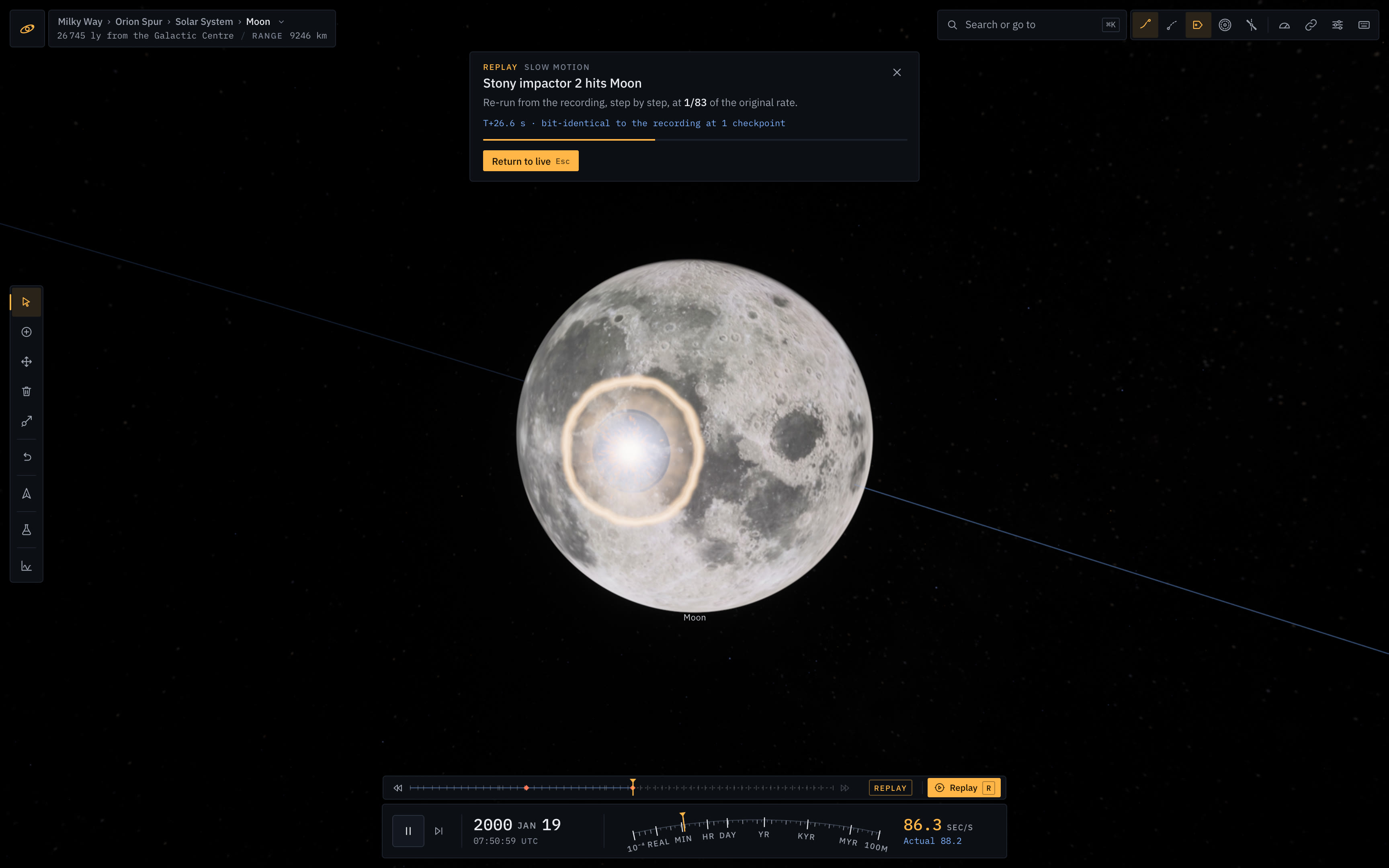
Rewind. Replay. What if?
Scrub back through time, replay an impact in slow motion, then change history.
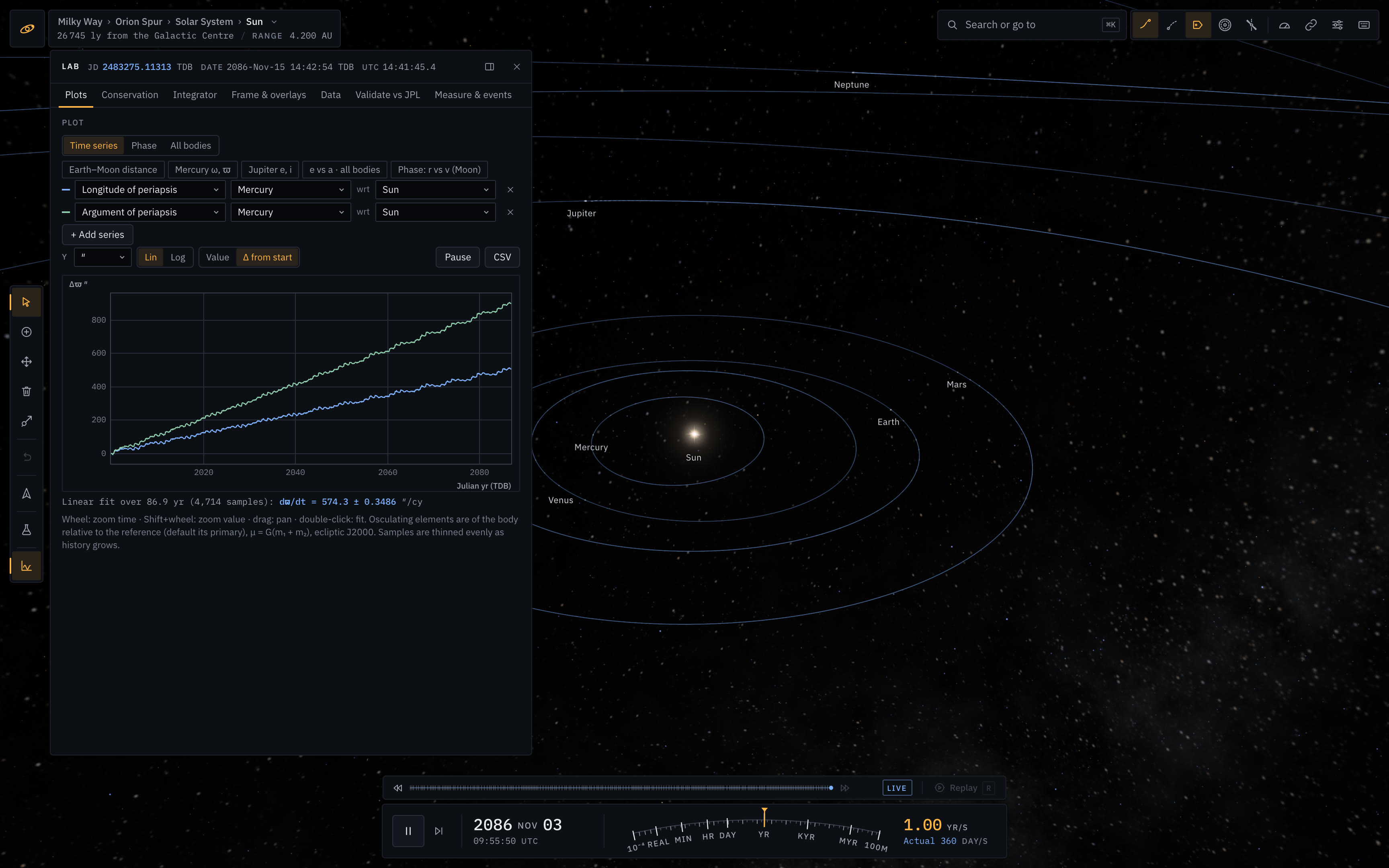
A lab for real work.
Plot orbital elements, watch conservation laws, validate against NASA JPL, export CSV or JSON.
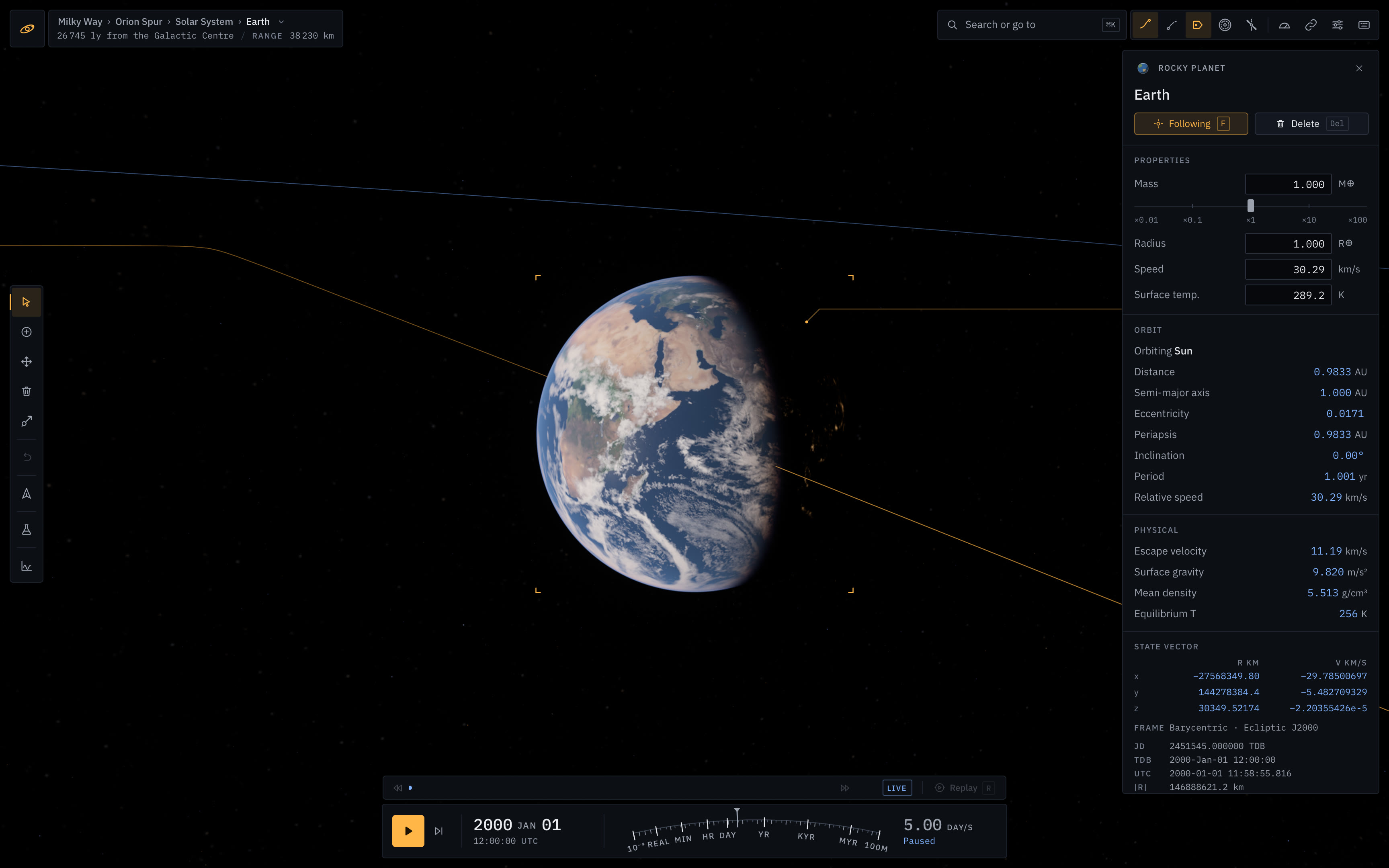
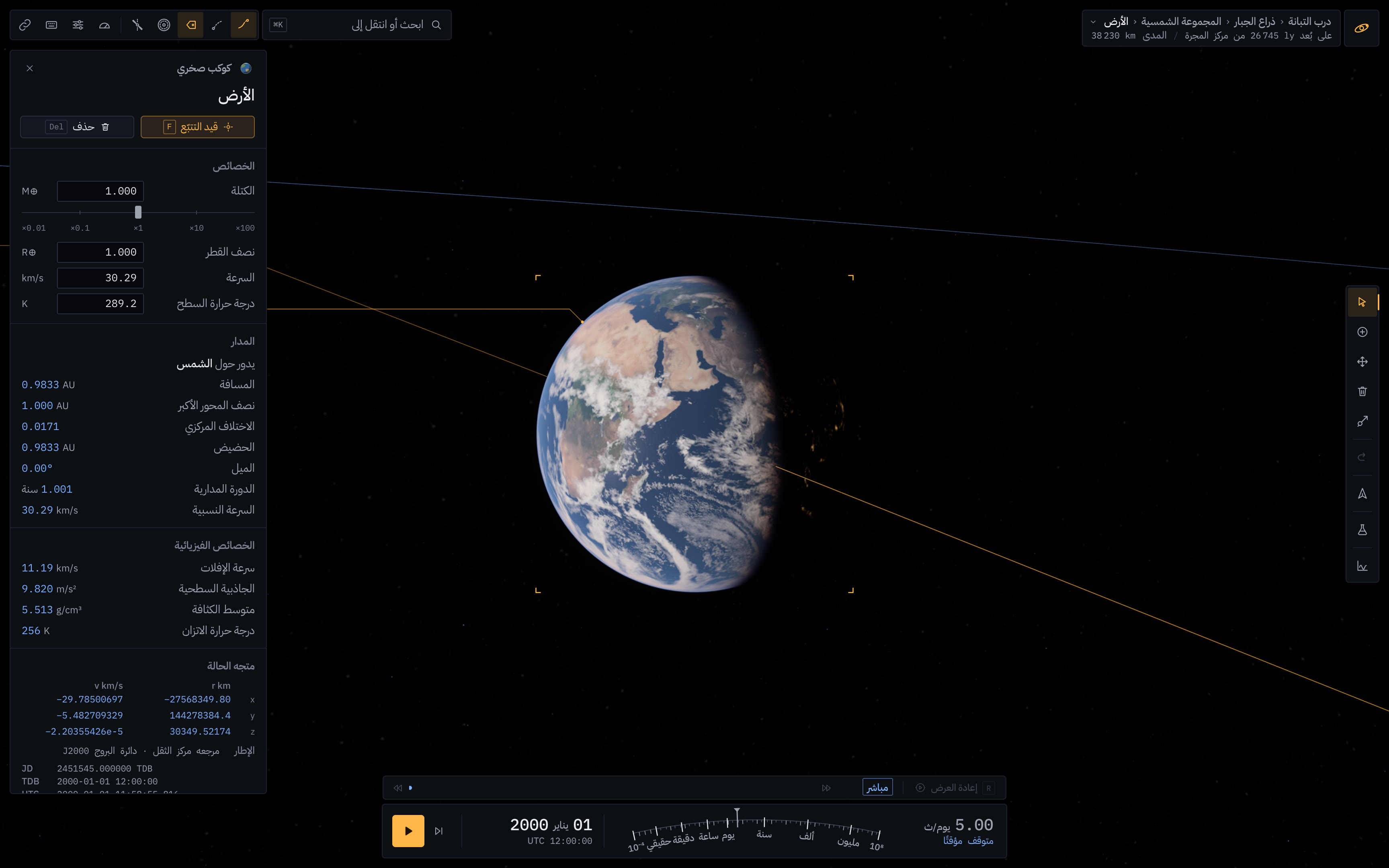
Arabic and English.
Every word in both, with a mirrored right-to-left interface.
Start with the Solar System.
Free, in your browser. No account.
Universe runs on a desktop computer. Send yourself the link.
What you need
- WebGPU
- Chrome or Edge 113+, Safari 26+
- Or WebGL 2
- Other desktop browsers, fewer effects
- Internet
- For high-resolution imagery
- Desktop only
- Phones and tablets: not yet